The HLTH Journal·The Science
Continuous heart rate monitoring vs spot checks
Your heart rate at 9am on a Tuesday is not your resting heart rate. It is your heart rate at 9am on a Tuesday.
HLTH Science Team· May 2026 · 5 min read

Most ways to check your heart rate give you one number at one moment. Your heart rate changes by the minute, so one reading does not tell the whole story. Here is what you can learn when you watch it around the clock instead.
Key takeaways
- A spot check tells you where you were at one moment; continuous data tells you where you have been.
- A true resting heart rate is built from dozens of readings across multiple days.
- The morning surge, a stress spike and the deep-sleep low are all invisible to occasional checks.
- Measurement frequency matters as much as measurement accuracy.
Not all monitoring is the same
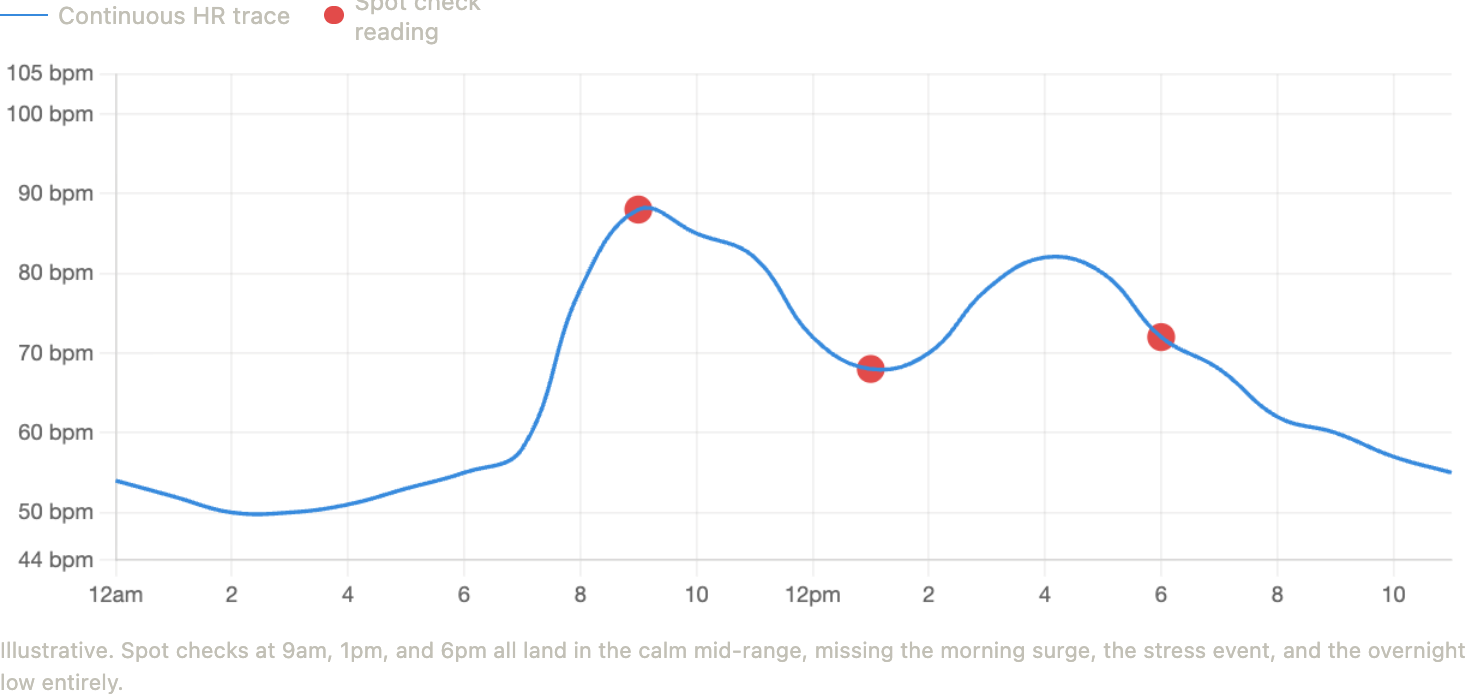
Heart rate tracking falls into three broad categories, and they are not equally useful. A spot check gives you one reading at one moment. A phone camera, a fingertip oximeter or a manual pulse count tells you your heart rate right now, and nothing before or after. It is blind to trends, to patterns, and to everything that happens between checks. Workout-only tracking covers active sessions. It follows your heart rate during exercise and stops when the session ends, which is useful for training zones but misses everything outside the gym. It is blind to resting patterns, to sleep, and to daily stress. Continuous 24/7 monitoring measures without stopping. It captures rest, sleep, activity and every transition between them, building a complete picture over time. That is what reveals trends, anomalies and recovery patterns. The difference is not just convenience. It is the difference between a photograph and a film.
What a single reading cannot show you
Your heart rate at 9am on a Tuesday is not your resting heart rate. It is your heart rate at 9am on a Tuesday. It reflects whatever happened in the hour before you checked: how you slept, whether you rushed to get ready, what you had to drink, whether you are fighting something off. A true resting heart rate is built from dozens of readings taken across multiple days. It only becomes reliable when the data is continuous.
Four things continuous monitoring reveals
The morning surge. Heart rate rises sharply in the first minutes after waking. This surge is a known cardiovascular signal, and it is completely invisible to spot checks taken later in the day. Masked elevation. A resting heart rate that runs persistently high can go unnoticed for months if you only check occasionally. Continuous data flags an elevated baseline before it becomes something you notice yourself. The stress response. A difficult meeting, a hard conversation, a near-miss in traffic: each one produces a measurable spike. Over time, the pattern of how often those spikes occur and how long they last tells you something about your daily stress load. Recovery tracking. How quickly your heart rate returns to baseline after exercise is a reliable marker of cardiovascular fitness. Tracking that descent requires continuous data, because a single post-workout reading gives you one point on the curve.
Why trends require time
A single day of data is interesting. A week is useful. A month starts to show you something real. Your resting heart rate baseline can only be calculated reliably once you have enough readings to separate signal from noise, and that requires days and nights of unbroken data rather than a handful of moments. This is why measurement frequency matters as much as measurement accuracy. A highly accurate reading taken once a day is still only one point. A continuous reading with a small margin of error builds a picture that a perfect spot check never could.
How the band approaches this
The HLTH Band measures heart rate 24 hours a day, seven days a week. There is no screen to drain the battery, so the sensor does not need to pause to conserve power, and the band runs for weeks on a single charge. That matters because your data does not break when the device goes on the charger. The app turns that continuous stream into a daily picture built from the whole day rather than a snapshot.