
The HLTH Journal·Training
How fitness changes your resting heart rate
Weeks one to four usually show nothing. That is where most people give up, and it is the part worth knowing in advance.
HLTH Science Team· May 2026 · 5 min read

When you get fitter, your resting heart rate goes down. A strong heart pumps more blood with each beat, so it does not have to work as hard. Here is why that happens, what accelerates it, and how long it realistically takes.
Key takeaways
- A stronger heart has a larger stroke volume, so fewer beats are needed at rest.
- Aerobic training is the biggest lever; sleep, hydration and stress management follow.
- Expect little visible change in the first four weeks.
- Judge the rolling weekly average, never a single morning.
Why fit people have lower resting heart rates
The heart is a muscle. Like any muscle, consistent training makes it stronger. A stronger heart has a larger stroke volume, meaning it moves more blood per beat, and when that happens the body needs fewer beats per minute to maintain circulation at rest. This is why endurance athletes often sit in the low 50s or even the high 40s, while a sedentary adult typically sits closer to 70 to 80 bpm. The drop is not just about exercise capacity. It reflects a genuine structural change in how the heart works. That change takes weeks to build, and it reverses gradually if training stops.
What actually moves the number
Not all methods have the same impact. Roughly in order of effect: Aerobic training is the most powerful lever. Activities that keep your heart rate elevated for sustained periods, such as running, cycling, swimming and brisk walking, drive the cardiac adaptations that lower resting heart rate over time. Aim for at least 150 minutes of moderate aerobic activity per week. Consistency matters more than intensity. Sleep quality has a measurable effect. One poor night can push your morning resting heart rate up by 5 to 10 beats, and chronic poor sleep keeps it elevated. Prioritising 7 to 9 hours lowers your baseline, often within days of improving sleep habits. Hydration affects heart rate because blood volume is partly water. When you are under-hydrated the heart compensates by beating faster, so staying consistently well hydrated removes a common source of artificial elevation. Stress management matters over longer time periods. Chronic stress keeps the nervous system in a low-level alert state, which keeps resting heart rate elevated. Regular breathwork, time outdoors and reducing background load all contribute, though the effects are slower and less dramatic than aerobic training.
How long does it take?
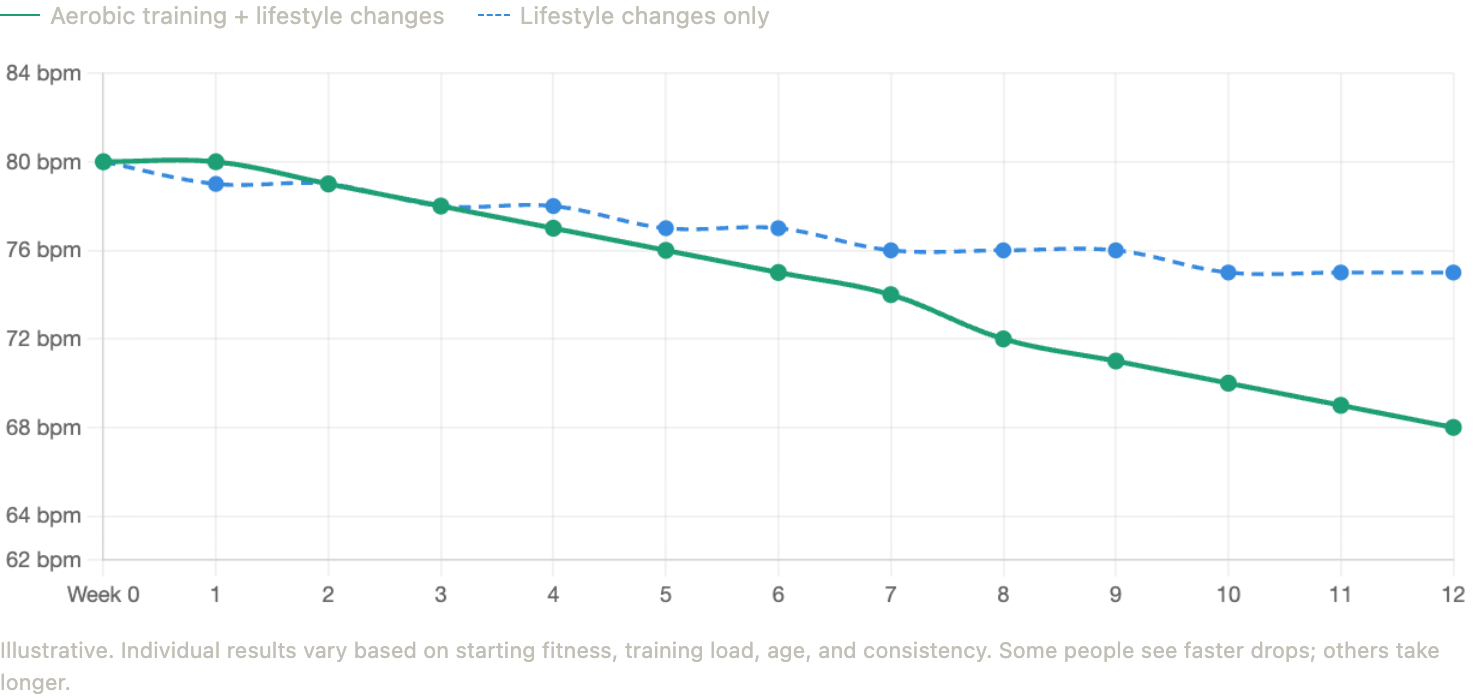
This is where most people’s expectations run ahead of reality. Weeks one to four typically show little visible change. The body is adapting, but the numbers often stay flat. This is where most people give up too soon. By weeks five to eight, a consistent training pattern usually produces a noticeable downward trend. By weeks ten to twelve, a meaningful drop, often 8 to 12 bpm below the starting point, is a realistic outcome for someone who was sedentary to begin with. Lifestyle changes alone, without regular aerobic training, still produce a real improvement. But the ceiling is lower and the timeline is similar. Training is the difference between a modest reduction and a substantial one.
Why your daily number fluctuates
Even as your baseline trends downward, individual day-to-day readings will vary. A hard session, a late night, a glass of wine or a stressful morning can each push a single reading several beats above your recent average. This is normal and expected. The number that matters is not any single reading. It is the rolling average across multiple days, measured at rest, ideally during sleep or first thing in the morning before you get up. That average, tracked weekly, is what shows you whether the trend is moving in the right direction.