The HLTH Journal·Heart Health
Resting heart rate during sleep: what your nights reveal
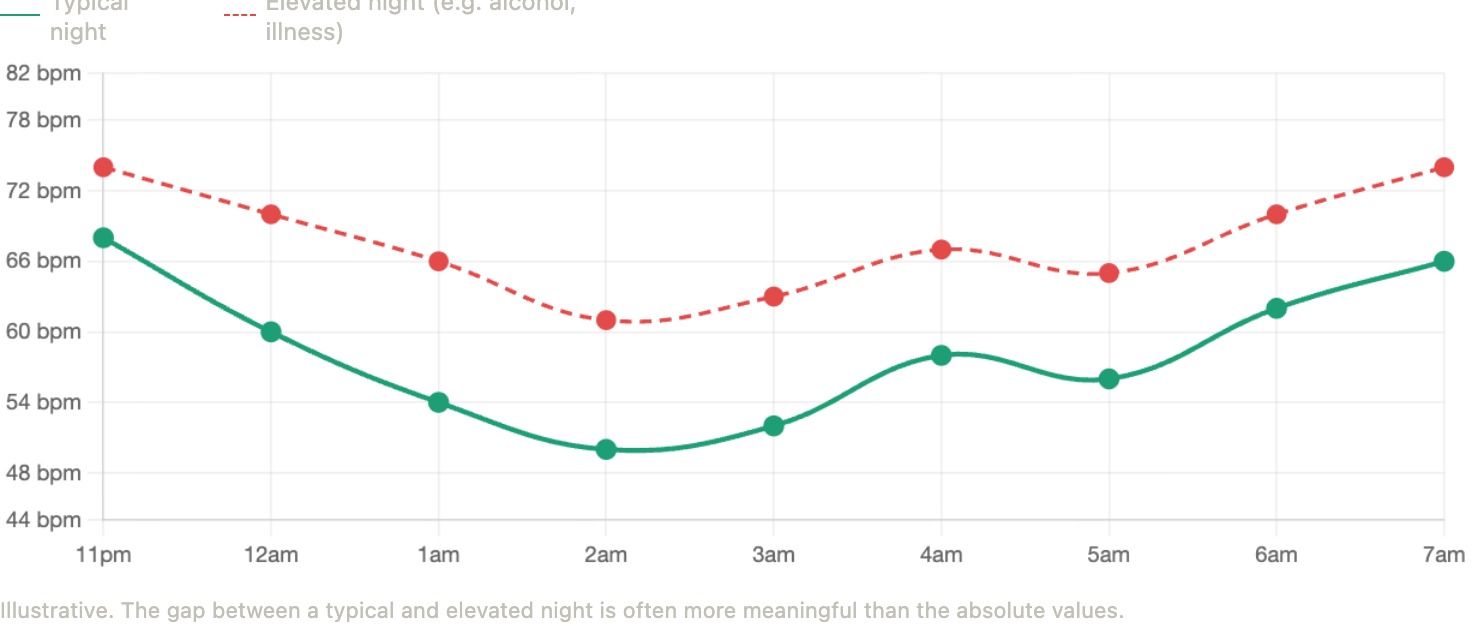
A night that runs 8 to 10 bpm above your own average is worth noticing, even when the raw number looks unremarkable.
HLTH Science Team· May 2026 · 5 min read

Your heart slows down when you sleep. That is normal and a good sign. But if your sleep heart rate is higher than usual, your body is often trying to tell you something. A drink the night before, the start of an illness, a hard training session or a late stressful event can all push your nighttime numbers up.
Key takeaways
- Sleep heart rate normally runs 10 to 30 bpm below your waking resting rate.
- The lowest point is usually during deep sleep in the first half of the night.
- What matters is the gap from your own recent average, not the absolute number.
- Alcohol, illness, hard training and late-night stress are the four usual causes of an elevated night.
Why your heart rate drops during sleep
During sleep your body shifts into a parasympathetic state. The parasympathetic nervous system is sometimes called rest and digest: it slows breathing, lowers blood pressure and reduces the demand on your heart. Less demand means fewer beats per minute. For most adults, sleep heart rate runs 10 to 30 bpm below their waking resting heart rate. If your resting rate during the day is around 70 bpm, a nighttime reading of 50 to 60 bpm is entirely normal. The lowest point typically occurs during deep, slow-wave sleep in the first half of the night.
Pattern matters more than the absolute number
There is no single number that is correct for everyone. What matters is your personal pattern over time. A sleep heart rate of 48 bpm might be typical for you; for someone else it might be unusual. The useful signal is not where your number sits tonight, but how it compares to your recent baseline. A night that runs 8 to 10 bpm above your recent average is worth noting, even if the raw number looks unremarkable.
What a high sleep heart rate can signal
Alcohol is one of the most consistent elevators of sleep heart rate. Even a moderate amount disrupts the parasympathetic state that allows the heart to slow down properly. Many people who track their sleep heart rate notice the effect clearly the morning after drinking, often before they notice it in how they feel. Illness and infection push sleep heart rate up before other symptoms become obvious. The immune response increases metabolic demand and raises body temperature, both of which require the heart to work harder. A two or three night run of elevated readings, with no lifestyle explanation, is sometimes the first sign that something is coming. Poor recovery after intense training can produce the same pattern. A hard session the evening before, or accumulated fatigue from a heavy training week, keeps the nervous system in a more activated state overnight. Sleep heart rate that stays elevated across multiple nights without illness or alcohol is often a sign that the body needs more recovery time. Late-night stress, whether an argument, anxious thoughts or a difficult phone call close to bedtime, can delay the shift into parasympathetic dominance and push the early part of the sleep trace upward.
How to read your overnight data
A single elevated night is rarely meaningful on its own, particularly if there is an obvious cause. What is worth paying attention to is a run of elevated nights without a clear explanation, or a gradual upward drift in your nightly average over one to two weeks. The band tracks heart rate continuously through the night, which means the app captures the full shape of your overnight trace rather than a single overnight average. That is useful because the timing of an elevation, whether it appears in the first half of the night or the second, gives additional context about whether it is more likely tied to recovery, stress or illness.