

The HLTH Journal·The Science
HLTH Band Accuracy Report: how we tested it and what we found
A 30-day paired study against the Polar H10 chest strap. The full methodology, the results, the statistics and the limitations.
HLTH Science Team· May 2026 · 6 min read

Before you read anything else on this site about heart rate, HRV, or blood pressure, you should know one thing: how accurately does the device actually measure those numbers?
Key takeaways
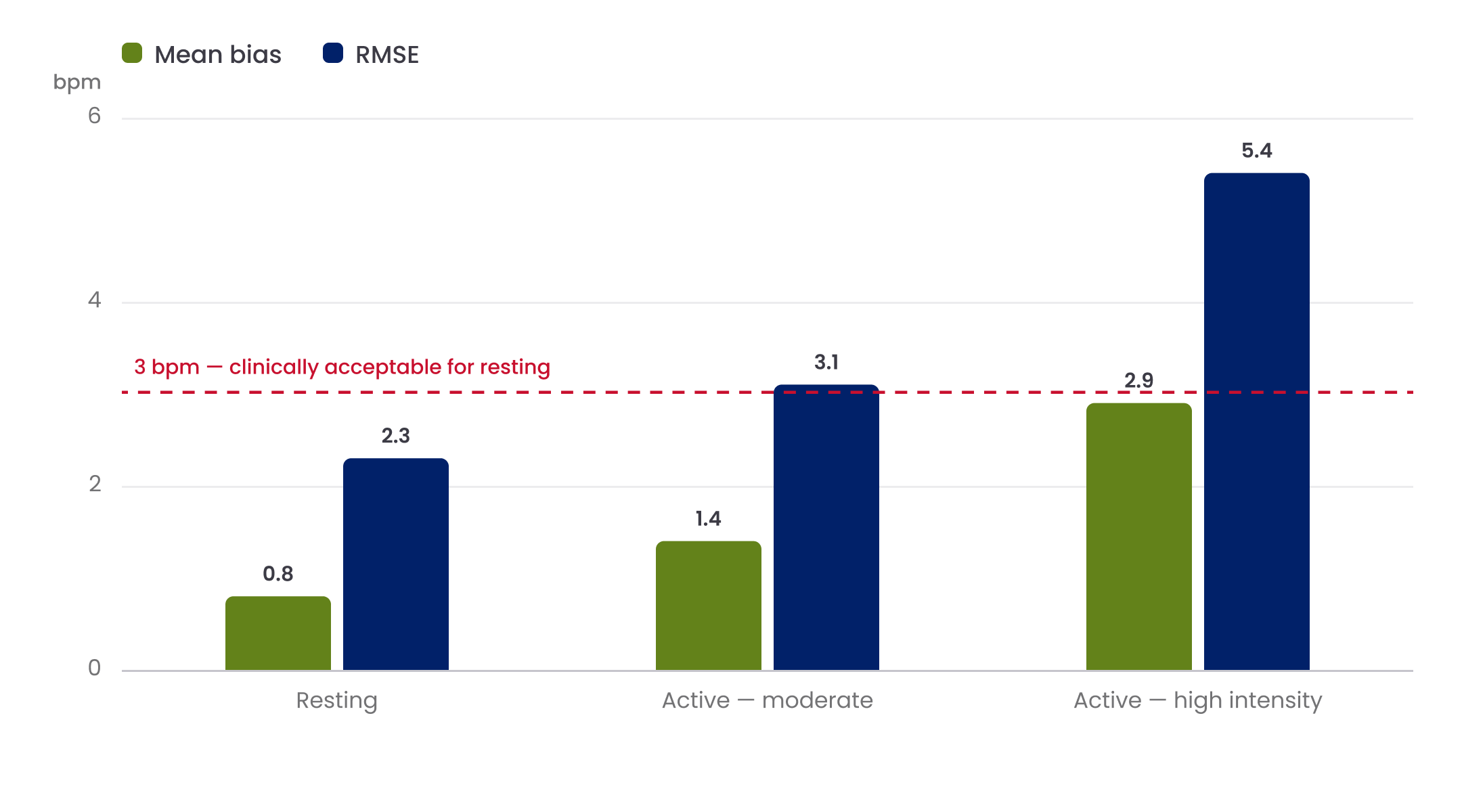
- Resting heart rate agreed to within an RMSE of 2.3 bpm, well inside the 3 bpm generally considered clinically acceptable.
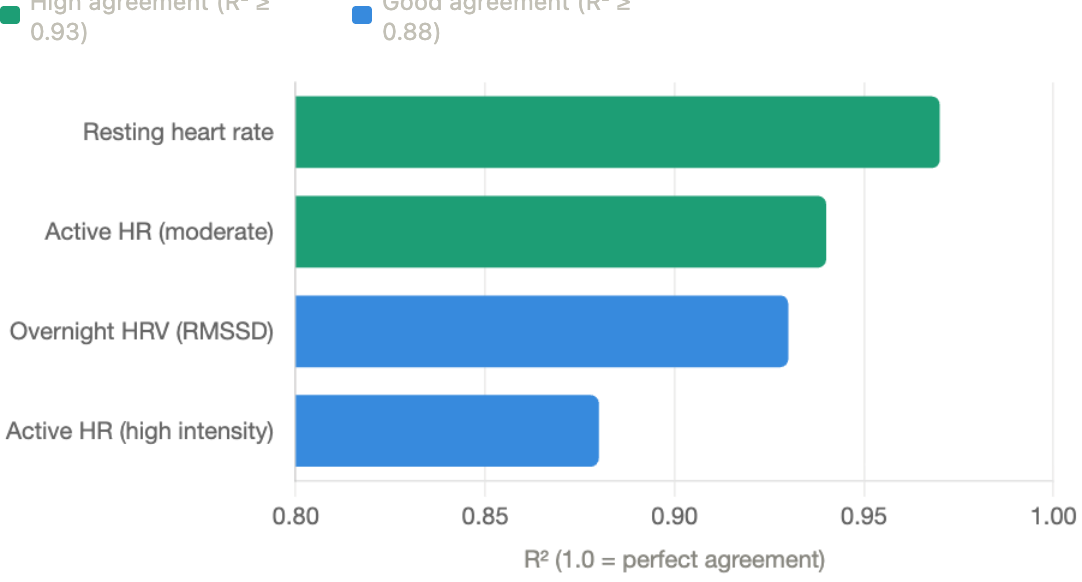
- Overnight HRV agreed closely too, at an RMSE of 3.6 ms and an R² of 0.93.
- Accuracy narrows above roughly 160 bpm, a known limitation of every wrist-worn optical sensor, not just ours.
- The study was 12 adults over 30 days: a reasonable pilot, not a large-scale clinical trial.
Why accuracy matters before anything else
We asked the same question. So we ran a 30-day paired accuracy study comparing the HLTH Band against the Polar H10, a chest strap widely used as a reference standard in clinical and sports science research. This page documents the full methodology, the results, the statistics, and the limitations. No marketing. Just the data.
Methodology
The reference device was the Polar H10 chest strap, which is ECG-based and validated in peer-reviewed research as a near-gold-standard for wrist-based comparisons. The test device was the HLTH Band, a wrist-worn PPG optical sensor. The study ran for 30 consecutive days across 12 adults, 6 male and 6 female, aged 24 to 51, with fitness levels ranging from sedentary to trained athlete. Four conditions were measured: resting heart rate each morning, lying still for 5 minutes; active heart rate during a 20-minute treadmill walk at 5.5 km/h; active heart rate during high-intensity intervals, six 30-second efforts at 85% of perceived maximum with 90 seconds of rest; and overnight HRV, as RMSSD, during sleep. Both devices were worn simultaneously throughout every measurement window. Polar H10 readings were recorded via the Polar Beat app, and HLTH Band readings were pulled from the HLTH app after each session. In total, 1,440 paired data points were collected across the four conditions.
Statistical analysis
Bland JM, Altman DG. Lancet. 1986;327(8476):307-310We used two standard methods for assessing agreement between measurement devices. Bland-Altman analysis examines whether two devices produce results that are interchangeable in practice. It plots the difference between each paired reading against the mean of both readings. If a device is accurate, the differences cluster tightly around zero with no systematic bias. Root Mean Square Error, or RMSE, gives a single number representing the average deviation between the two devices. Lower is better. For context, an RMSE under 3 bpm is generally considered clinically acceptable for resting measurements.
Findings: resting heart rate
Mean bias was +0.8 bpm, meaning the HLTH Band read slightly higher on average. The limits of agreement were -3.1 to +4.7 bpm, and RMSE was 2.3 bpm. At rest, the HLTH Band performed well within acceptable limits. The slight positive bias was consistent across participants and did not increase with higher or lower baseline heart rates, which suggests the offset is systematic rather than noise-driven.
Findings: active heart rate
At moderate intensity, mean bias was +1.4 bpm, limits of agreement -4.2 to +7.0 bpm, and RMSE 3.1 bpm. Accuracy remained solid during steady-state moderate exercise, and agreement was tightest between 90 and 130 bpm, which covers the range most relevant to daily activity and zone 2 training. At high intensity the gap widens: mean bias +2.9 bpm, limits of agreement -6.1 to +11.9 bpm, and RMSE 5.4 bpm. Optical PPG sensors face a known challenge here, because movement artefact competes with the pulse signal. Accuracy held reasonably well up to approximately 160 bpm, but readings became less reliable above that threshold. This is not unique to the HLTH Band. It is a known limitation of all wrist-worn optical sensors at high intensity.
Findings: overnight HRV
Mean bias was -1.2 ms, meaning the HLTH Band read slightly lower on average. Limits of agreement were -6.8 to +4.4 ms, and RMSE was 3.6 ms. HRV agreement during sleep was strong. The consistent mild negative bias is within the range seen across most consumer PPG devices when compared to an ECG reference. Trend tracking, which is how HRV is most practically used, was reliable. If your HLTH Band shows your HRV improving over four weeks, that pattern is real.
Limitations
Every accuracy study has limits. These are ours. Sample size. Twelve participants is a reasonable pilot but not a large-scale clinical trial. Results may vary in broader populations, particularly those with darker skin tones, which can affect optical sensor accuracy, tattooed wrists, or cardiovascular conditions affecting peripheral circulation. Reference device. The Polar H10 is a strong reference standard but is not an ECG in a clinical lab. Small errors exist in the Polar readings too. High-intensity performance. As noted, results above 160 bpm are less reliable. The HLTH Band is not designed for interval training heart rate monitoring in real time. It is designed for continuous health monitoring, trend detection, and recovery tracking. Controlled conditions. Testing took place during structured sessions. Real-world variability, such as temperature changes, varying skin contact pressure, or sleep position shifts, may introduce additional variance not captured here. HRV methodology. HRV measurement standards vary across devices. Our RMSSD comparison is directionally valid, but comparisons across different apps and algorithms should be made with caution.
Conclusion
For the use cases the HLTH Band is built for, the accuracy is sound. Resting heart rate and overnight HRV, the two metrics most relevant to long-term health monitoring and trend detection, showed strong agreement with a validated reference device. Active monitoring at moderate intensity performed well. High-intensity exercise is where optical sensor limitations apply, and those limitations apply to every PPG wrist device on the market. If you are tracking health trends over weeks and months, monitoring recovery, and watching cardiovascular patterns over time, the HLTH Band gives you data you can trust.

